Move from drawing to validated part without losing time.
Short-run, prototype, and production parts for teams working against a real launch date. Tell us what matters; we will show you what moves first.
Preparing your production signal.
Speed with the evidence attached.
Every estimate starts with your material, volume, and delivery window. A manufacturing engineer reviews the assumptions before we put a number in front of procurement.
Less waiting. Better decisions.
A compact production loop built for prototype, pre-series, and the parts that need to earn their way into a line.
Review the geometry
We interrogate the drawing for tolerance, datum, surface, and the assumptions hidden between the lines.
Select the process
CNC, additive, molding, or a hybrid path — chosen for the actual quantity and use case.
Prove the part
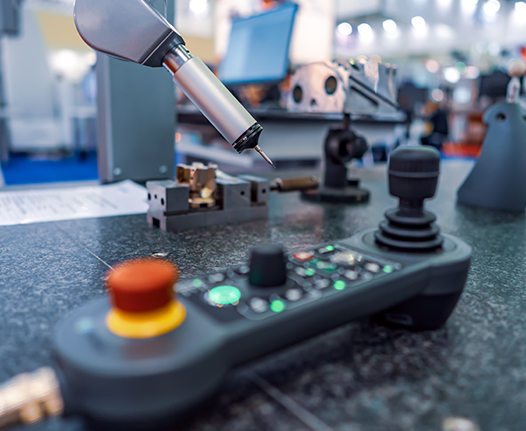
Inspection, material traceability, and the test evidence your internal gate requires.
Release with confidence
The validated part, its evidence, and the next production decision in one accountable handoff.
Material and operating conditions belong in the production brief.
The right production path starts with what the part must do, not only its geometry. Share these conditions early to reduce material or process changes after prototyping.
Select material for the job
Strength, stiffness, impact, weight, chemical exposure, temperature, finish, quantity, and target cost all affect material choice. Matching those needs to a suitable production process helps keep the part functional, manufacturable, and on schedule.
Design for temperature and pressure
Minimum and maximum service temperature, thermal cycling, working pressure, pressure spikes, and repeated cycles can affect dimensions, stiffness, creep, fatigue life, and sealing. Share the full operating range and any fluid or gas exposure so geometry, material, tolerances, joints, and validation can reflect real use.
A starting point for choosing a prototype material.
Compare the common options in our planning estimator. Use operating temperature, pressure, exposure, and loads—not a material name alone—to shortlist.
| Material | Common strengths | Trade-offs to check | Typical prototype fit |
|---|---|---|---|
| PLA | Easy to print with fine detail; useful for quick fit and form checks. | Lower heat resistance and can be brittle under impact; avoid assuming suitability for sustained loads or hot environments. | Visual, fit-check, and low-load prototypes. |
| PETG | Often chosen when a prototype needs a balance of toughness and straightforward printing. | Can deform under sustained load; confirm the exact grade’s temperature and chemical compatibility. | Covers, brackets, and general functional prototypes after reviewing the use conditions. |
| ABS | Often selected for impact resistance and parts that need more heat capability than PLA. | Print warping and orientation affect results; confirm the grade and process against the required operating range. | Functional enclosures and brackets with loads and temperature checked. |
| ASA | Useful when outdoor weathering and UV exposure matter. | Print conditions and warping need control; verify the grade’s heat and chemical limits. | Outdoor covers and housings after exposure review. |
| TPU | Flexible and resilient, with useful impact absorption. | Lower stiffness; hardness and geometry determine deformation, sealing, and pressure performance. It is not a pressure rating. | Flexible grips, bumpers, and compliant interfaces. |
| Nylon | Tough and wear-resistant, often useful for moving or rubbing parts. | Moisture uptake can change dimensions and properties; grade, drying, and process conditions matter. | Clips, wear components, and moving prototypes. |
Qualitative guidance only. Actual performance depends on the exact grade, process, print orientation, geometry, and environment. Check the supplier datasheet and validate a representative part. Do not use this comparison alone to qualify pressure-bearing or safety-critical parts.
See the systems behind the signal.
A better production decision is easier to make when the process, the part, and the evidence are visible in the same frame.